Visual literacies play a central role in early reading and writing development. But as children progress into more traditionally print-heavy settings, we tend to lose sight of all there is to see. Today, we'll take a closer look at visual literacies within the context of multimodal texts.
|
Objectives
1. Interpret what it means to 'read the visual' by drawing on theories for literacy instruction. 2. Apply our understandings of visual literacies to children's picturebooks in order to make meaning from the theory. 3. Connect our understandings of visual literacies to instructional practice. |

|
Activities
1. Partner reading of New literacies in the elementary classroom: The instructional dynamics of visual-texts (Hassett, 2010). 2. Use Hassett's framework (2010) to analyze children's picturebooks. 3. Brainstorm potential applications for literacy classrooms, and identify areas for elaboration. |
Being aware of the different possibilities for meaning offered by multimodal texts means explicitly discussing how texts work to express ideas. This is equally important when considering a whole text or a single page. When reading, for example, what does a printed book afford as compared with watching a text on television ... How do we acknowledge and respond to children's increasingly frequent choice of using multimodal texts to represent meaning?"
Bearne, E. (2005). Multimodal Texts: What They Are and How Children Use Them. In J. Evans (Ed.), Literacy Moves On (pp. 13–29). Portsmouth, NH: Heinemann.
Paired Reading
15 minutes
With a partner (silently or aloud), read through the provided passage: New literacies in the elementary classroom: The instructional dynamics of visual-texts (Hassett, 2010, pp. 88-92). Your purpose for reading is to answer the following questions:
If there is extra time, consider the following:
- What do you think it means to ‘read the visual’?
- Why is this relevant to literacy instruction?
If there is extra time, consider the following:
- How might you strategically use visual texts within reading or writing instruction, and what purpose would this serve?

| Hassett (2010) |
Framework for Analyzing Picturebooks
25 minutes
Within the article, Hassett provides a framework for looking at the multimodal and interactive dimensions of visual-texts. Drawing on Serafini (2014), I refer to these as picturebooks to illustrate "the unity or cohesiveness of visual images, design elements, and written language" (p. 72). To better contextualize this theory, we will analyze picturebooks using the framework from the reading.
Today(1) Download the file below to get started. You will also need to find a partner and select a text. Take notes directly on the document as you work through the analysis.
(2) When you have finished taking notes, visit the shared Google Doc to share your findings with the class. 
|
In the FutureWhile by no means exhaustive, this resource provides a good starting point for seeking out these types of texts as mentor pieces to use in your classroom and OF COURSE to read for good old-fashioned fun! You might also revisit our shared doc to quickly locate texts that emphasize multimodal elements.
| ||||
"With visual texts, reading is not always a matter of 'getting' the author's meaning; instead, reading is about constructing a sense out of the mass cultural artifacts, tools, signs, and symbols at hand... Thus, teachers as facilitators of visual-text experiences design their learning spaces and activities in order to highlight multiple literacies of the children in our classrooms
(New London Group, 2000a)."
(Hassett, 2010, p.91)

|
Like what you read? Want to learn more?
The accompanying articles provide additional insight into what it means to engage student meaning making to read and write multimodal texts. Or make additional connections to practice by exploring the extension ideas below. |
| ||||
Reading Instruction
Designing Reading Experiences to Foster Visual LiteracyMaking meaning from images plays an important role in early reading and writing instruction. So consider how visual literacy might be a useful focus for a shared reading or interactive reading experience. Remember, it is important to consider your goal first, and then seek out a book that provides a great opportunity for students to see and explore those dimensions. Click here for a refresher on crafting shared reading experiences.
|
Digital Literacies
Using Author's Craft to
|
Critical Literacy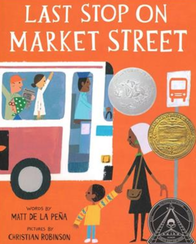
Analyzing Picturebooks from an Ideological PerspectiveIn his book, Reading the Visual, Serafini (2014) illustrates how to analyze picturebooks to account for multimodality, much as we just explored with Hassett's framework. Chapters 6-7 (below) go one step further offering a framework for analyzing picturebooks from an ideological perspective. Consider how these conversations can help students to identify and confront beliefs about their worlds.
| ||||

You wanna read in a box?
Then, read in a box.
Then, read in a box.
